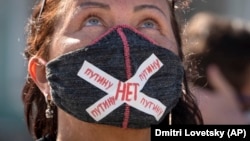
A woman wears a face mask with the message "No To Putin" during a protest against the constitutional amendments in St. Petersburg on July 1.
MOSCOW -- The day President Vladimir Putin declared victory in a vote on constitutional changes that pave the way for him to rule Russia until 2036, his spokesman Dmitry Peskov called it a "triumphal referendum on confidence" in the former KGB officer, who has already spent over two decades in power.
Official results of the weeklong vote that ended July 1 showed that 77.92 percent of Russian voters endorsed the constitutional changes, with only 21.26 against. Turnout was 68 percent, the Central Election Commission said.
"Such a high turnout and such a high level of support was very difficult to predict," Peskov said in a statement to reporters.
Other officials quickly chimed in.
"A plebiscite on trust in Putin ended with victory for the head of state," State Duma speaker Vyacheslav Volodin was quoted as saying in the lower house of parliament's official newspaper. Moscow Mayor Sergei Sobyanin lauded "a plebiscite on the consolidation of society around the Russian president."
Kremlin critics were struck by the retroactive portrayal of the vote as a plebiscite on support for Putin. His name was almost completely absent from promotional material and TV reports urging Russians to vote on a package of over 200 constitutional amendments -- despite the fact that a clause allowing Putin to reset term limits was among the most consequential of them.
They also alleged that the high turnout and support reflected in official results were engineered to conform with targets set down well in advance by Putin's aides.
"The updated 'results' are fake and a huge lie," said opposition politician Aleksei Navalny, who had called on his supporters to boycott the vote. "They have nothing in common with the opinion of Russia's citizens."
Claims of fraud quickly began mounting.
The most damning came from Sergei Shpilkin, a prominent electoral researcher who uses data from Russia's Central Election Commission during voting cycles to plot tallies reported at polling stations throughout the country and detect evidence of inflated turnout.
During the presidential election of 2018, which Putin won handily, Shpilkin saw that the data showed numerous polling stations reporting turnout percentages ending in 0 or 5, suggesting, per his widely cited analysis, that almost 10 million votes were falsified at the ballot box.
This time, Shpilkin said, that figure was an "unprecedented" 22.4 million.
Adding to the murky picture, exit polls conducted by anti-government activists in Moscow and St. Petersburg showed that a small majority in the two cities -- both strongholds of the embattled opposition -- had voted against the proposed changes. But the activists could only record the views of voters who agreed to be interviewed, meaning they had few means of gauging the actual scale of ballot manipulation.
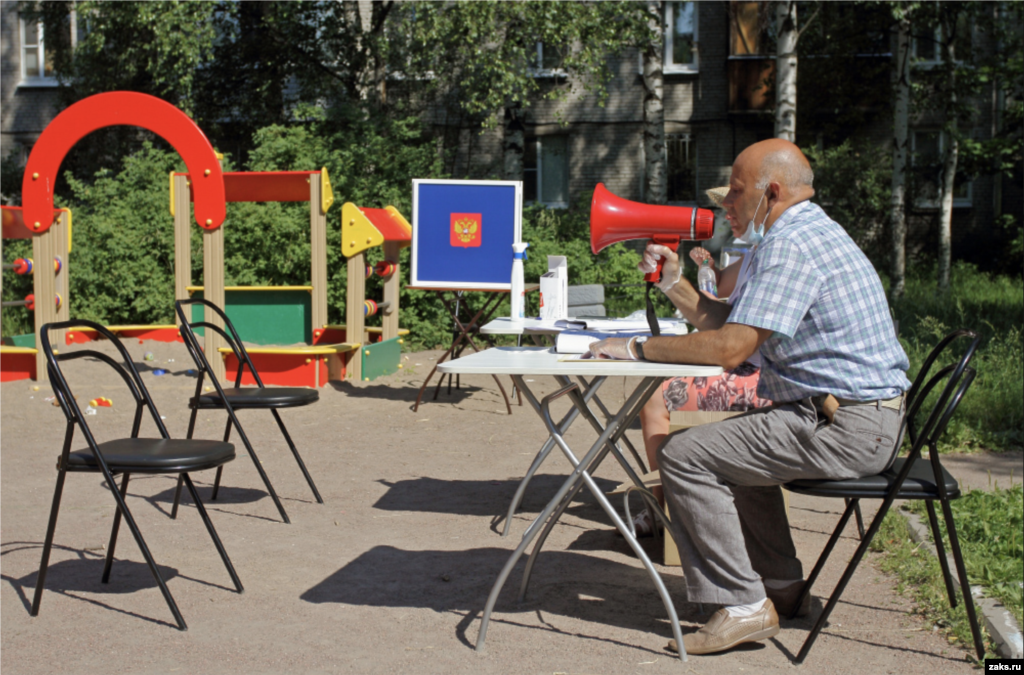
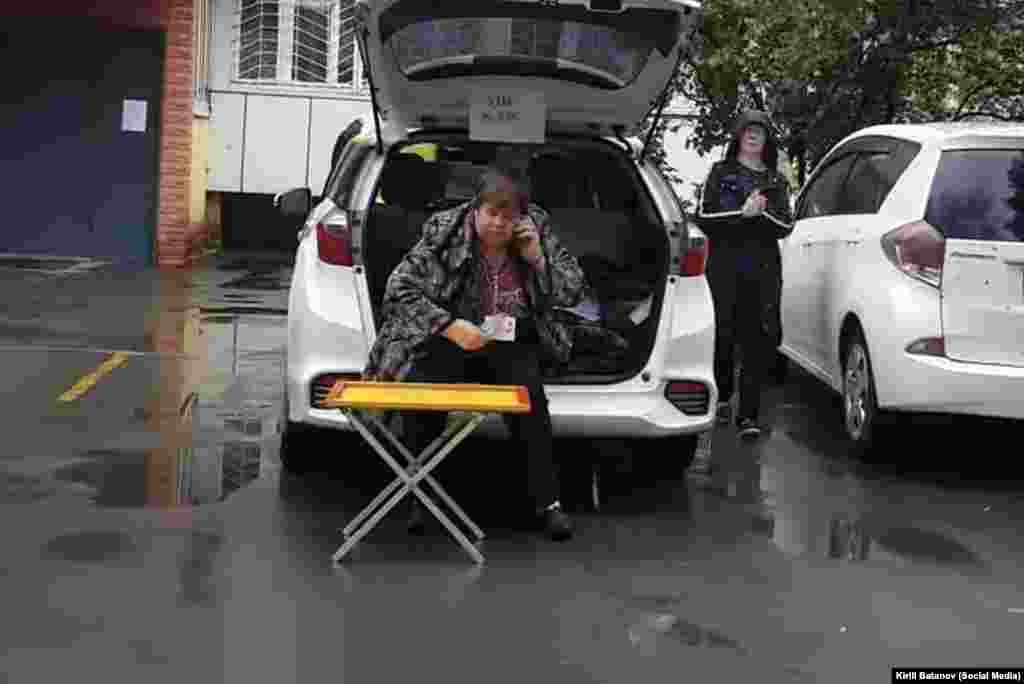
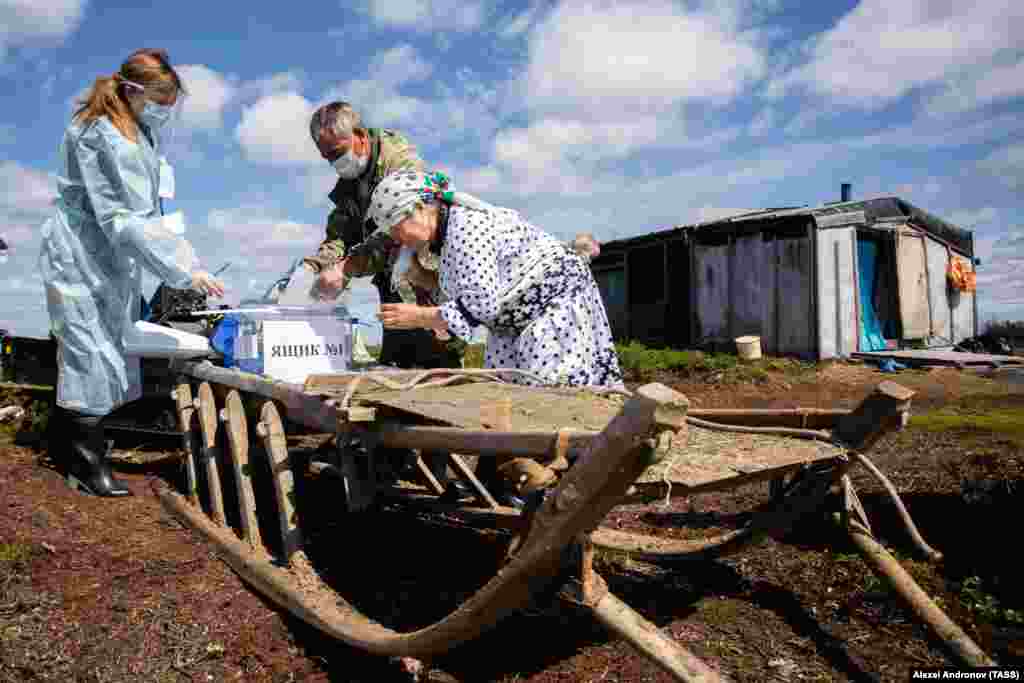
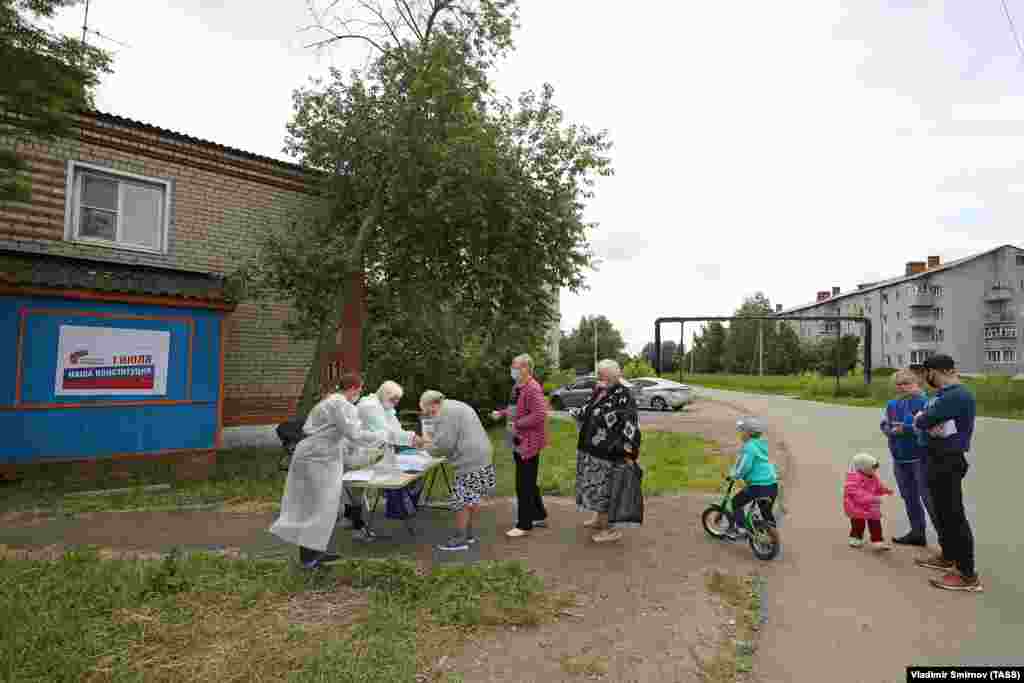
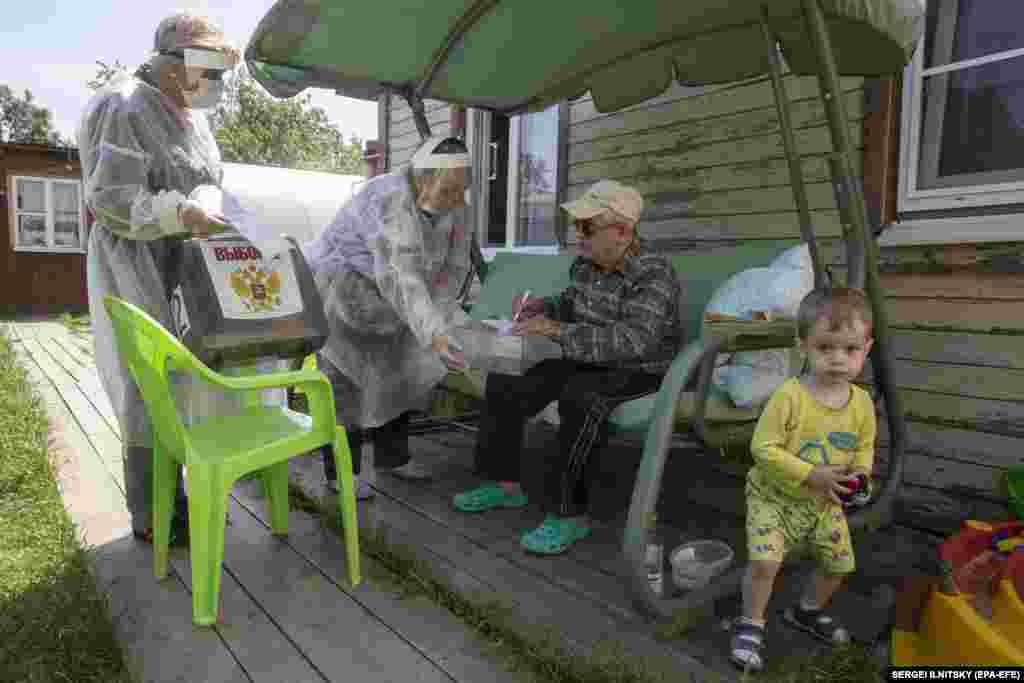
The plebiscite was marred by inconsistencies from the start, not least because few official rules governed its execution. From the first day of voting, Russians could cast ballots in car trunks, parked buses and on tree stumps, as evidenced by various images posted to social media from across the country.
Playgrounds, Airports, Automobiles: Russia's Drive To Get Out The Vote, Anywhere And Everywhere
1/15A children's playground served as a polling site in the city of Pushkin on June 25. Election officials used a megaphone to call residents to come and cast their ballots.
From parking lots and playgrounds to railway stations and airports, Russian authorities have opened polling stations in some unusual places to boost turnout in a controversial vote that could allow President Vladimir Putin to serve another two terms in office. Russians began nationwide voting on June 25 for constitutional reforms that could pave the way for Putin to remain as the country's president until 2036.
2/15A boy rides his scooter past an outdoor polling station in St. Petersburg. Voting began on June 25 and is scheduled to last until July 1.
From parking lots and playgrounds to railway stations and airports, Russian authorities have opened polling stations in some unusual places to boost turnout in a controversial vote that could allow President Vladimir Putin to serve another two terms in office. Russians began nationwide voting on June 25 for constitutional reforms that could pave the way for Putin to remain as the country's president until 2036.
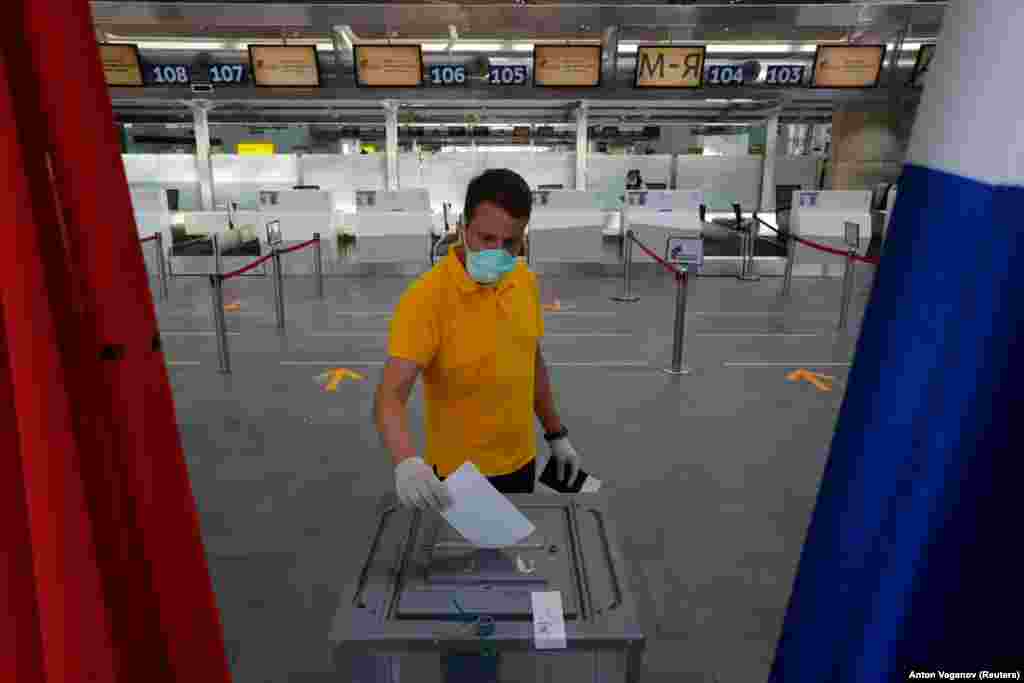
3/15A man casts his ballot at a polling station created at Pulkovo International Airport in St. Petersburg on June 25. Authorities opened polling stations a week early and are letting voters cast ballots over a seven-day period to stop overcrowding amid the coronavirus pandemic.
From parking lots and playgrounds to railway stations and airports, Russian authorities have opened polling stations in some unusual places to boost turnout in a controversial vote that could allow President Vladimir Putin to serve another two terms in office. Russians began nationwide voting on June 25 for constitutional reforms that could pave the way for Putin to remain as the country's president until 2036.
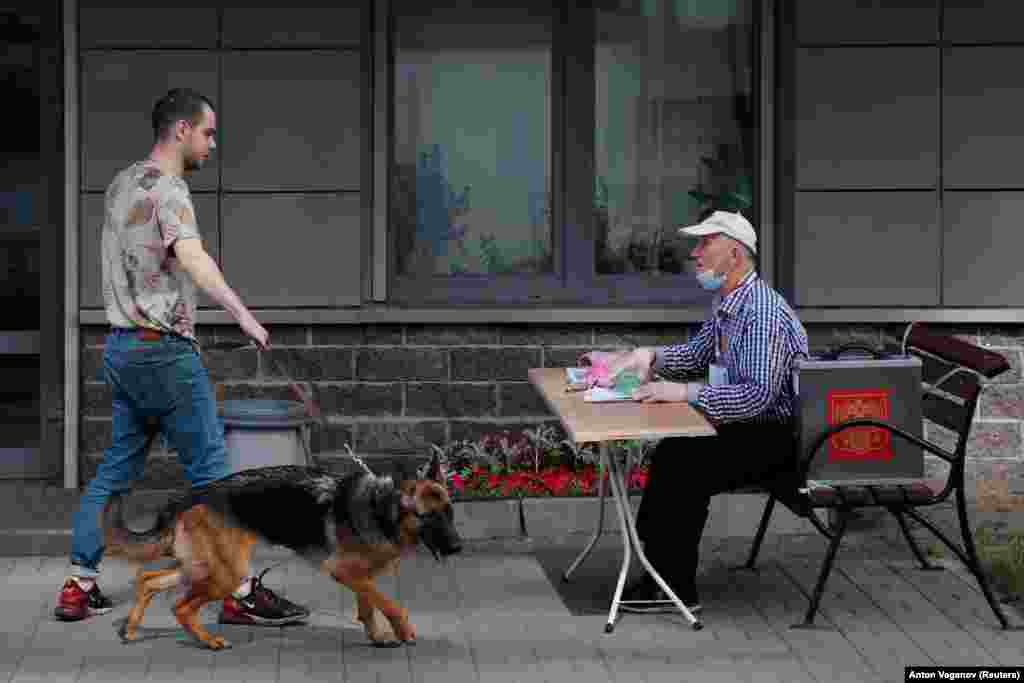
4/15A voter in St. Petersburg took his dog to an outdoor polling station.
From parking lots and playgrounds to railway stations and airports, Russian authorities have opened polling stations in some unusual places to boost turnout in a controversial vote that could allow President Vladimir Putin to serve another two terms in office. Russians began nationwide voting on June 25 for constitutional reforms that could pave the way for Putin to remain as the country's president until 2036.
5/15Voting from the back of a car in Russia's Pacific port city of Vladivostok. Vladimir Putin's last term as president was supposed to end in 2024. But if the constitutional amendment is approved, he would be allowed to run twice more.
From parking lots and playgrounds to railway stations and airports, Russian authorities have opened polling stations in some unusual places to boost turnout in a controversial vote that could allow President Vladimir Putin to serve another two terms in office. Russians began nationwide voting on June 25 for constitutional reforms that could pave the way for Putin to remain as the country's president until 2036.
6/15A polling tent in the Siberian city of Novosibirsk on June 25
From parking lots and playgrounds to railway stations and airports, Russian authorities have opened polling stations in some unusual places to boost turnout in a controversial vote that could allow President Vladimir Putin to serve another two terms in office. Russians began nationwide voting on June 25 for constitutional reforms that could pave the way for Putin to remain as the country's president until 2036.
7/15Outdoor voting benches in the city of Linevo on June 25
From parking lots and playgrounds to railway stations and airports, Russian authorities have opened polling stations in some unusual places to boost turnout in a controversial vote that could allow President Vladimir Putin to serve another two terms in office. Russians began nationwide voting on June 25 for constitutional reforms that could pave the way for Putin to remain as the country's president until 2036.
8/15A parking-lot polling station in the Zakamsk district of Perm
From parking lots and playgrounds to railway stations and airports, Russian authorities have opened polling stations in some unusual places to boost turnout in a controversial vote that could allow President Vladimir Putin to serve another two terms in office. Russians began nationwide voting on June 25 for constitutional reforms that could pave the way for Putin to remain as the country's president until 2036.
9/15Residents of a remote Khanty cattle camp take part in early voting.
From parking lots and playgrounds to railway stations and airports, Russian authorities have opened polling stations in some unusual places to boost turnout in a controversial vote that could allow President Vladimir Putin to serve another two terms in office. Russians began nationwide voting on June 25 for constitutional reforms that could pave the way for Putin to remain as the country's president until 2036.
10/15Residents visit an outdoor polling station in the village of Lugovoye.
From parking lots and playgrounds to railway stations and airports, Russian authorities have opened polling stations in some unusual places to boost turnout in a controversial vote that could allow President Vladimir Putin to serve another two terms in office. Russians began nationwide voting on June 25 for constitutional reforms that could pave the way for Putin to remain as the country's president until 2036.
11/15A woman casts her vote at a polling station inside Moscow's Kazansky railway station.
From parking lots and playgrounds to railway stations and airports, Russian authorities have opened polling stations in some unusual places to boost turnout in a controversial vote that could allow President Vladimir Putin to serve another two terms in office. Russians began nationwide voting on June 25 for constitutional reforms that could pave the way for Putin to remain as the country's president until 2036.
12/15Mobile polling-station workers wear protective gear as they visit homes in the village of Vostryakovo outside Moscow. The vote has raised concerns among health officials as the number of new coronavirus infections in Russia remains stubbornly high at above 7,000 a day.
From parking lots and playgrounds to railway stations and airports, Russian authorities have opened polling stations in some unusual places to boost turnout in a controversial vote that could allow President Vladimir Putin to serve another two terms in office. Russians began nationwide voting on June 25 for constitutional reforms that could pave the way for Putin to remain as the country's president until 2036.
13/15A voting bus on June 25 in Kazan, the capital of Russia's Republic of Tatarstan.
From parking lots and playgrounds to railway stations and airports, Russian authorities have opened polling stations in some unusual places to boost turnout in a controversial vote that could allow President Vladimir Putin to serve another two terms in office. Russians began nationwide voting on June 25 for constitutional reforms that could pave the way for Putin to remain as the country's president until 2036.
14/15Outdoor voting for constitutional amendments in Kerch. The city and the rest of the Crimean Peninsula was forcibly annexed by Russia in 2014.
From parking lots and playgrounds to railway stations and airports, Russian authorities have opened polling stations in some unusual places to boost turnout in a controversial vote that could allow President Vladimir Putin to serve another two terms in office. Russians began nationwide voting on June 25 for constitutional reforms that could pave the way for Putin to remain as the country's president until 2036.
15/15A woman casts her vote in the city of Kerch. If Putin serves two more terms, he would be Russian president until 2036, when he would be 83.
From parking lots and playgrounds to railway stations and airports, Russian authorities have opened polling stations in some unusual places to boost turnout in a controversial vote that could allow President Vladimir Putin to serve another two terms in office. Russians began nationwide voting on June 25 for constitutional reforms that could pave the way for Putin to remain as the country's president until 2036.
Previous slide
Next slide
By the afternoon of July 1, the election commission was already reporting preliminary results, apparently in violation of laws that usually apply to national votes.
A Russian woman living in Israel reported that she'd been able to vote three times -- in Tel Aviv, in Haifa, and again online. At one Moscow polling station, a man was told that he and two of his children had already cast their votes -- despite insisting none of them had. A supervisor then seized the voter record, snapped it shut, and told the man, "Prove it!"
Daily raffles offered prizes to all who cast their ballot. Posters with "YES" written across them hung in the basements of apartment blocks in major cities. And at least one journalist who tried to document events inside a polling station was violently apprehended by police.
There was also plenty of evidence suggesting the vote had been a mere formality. At least two weeks before voting even began, bookshops across Moscow were selling copies of the Russian Constitution with the new amendments included.
In a statement on July 2, the day after voting ended, election monitor Golos issued a scathing assessment of the vote, saying that much of the balloting had been falsified -- and results partly determined in advance.
"The actual voting process had no significant meaning," the organization said. "An expression of the people's will was impossible from the start, because of the rules that were consciously put in place by the organizers."
Calling the vote "unprecedented" in terms of the scale of fraud and manipulation, the organization concluded that it will "go down in the country's history as an attack on the people's sovereignty."
Matthew Luxmoore is a Moscow-based journalist covering Russia and the former Soviet Union. He has reported for The New York Times in Moscow and has written for The Guardian, Politico, The New Republic, and Foreign Policy. He’s a graduate of Harvard’s Davis Center and a recipient of New York University's Reporting Award and the Fulbright Alistair Cooke Journalism Award.