




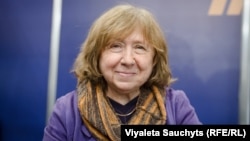
Forty years after the Chernobyl nuclear disaster, Nobel Prize–winning author Svetlana Alexievich says Belarus is still a "laboratory" in which the long-term effects of the massive radiation leak continue to play out.
Speaking to RFE/RL's Belarus Service, Alexievich said lessons of Chernobyl are being forgotten and more personal testimonies needed to be gathered.
"Belarus is still the Chernobyl laboratory. Chernobyl is still with us. It is impossible to forget it, because the radiation there, many radionuclides, will live for about 1,000 years," she said. "Now is the time for testimonies, we need to collect testimonies."
Alexievich, who won the Nobel Prize for Literature in 2015, interviewed more than 500 eyewitnesses for her seminal 1997 book, Voices From Chernobyl. The accounts in the book were extensively used in the landmark 2019 HBO miniseries about the tragedy.
What Happened At Chernobyl?
When a nuclear reactor exploded at the Chernobyl nuclear power station in the Soviet Union in 1986, it spewed radiation across the surrounding areas and across Europe. Belarus was the worst affected, receiving 60 percent of the initial fallout.
A report by the United Nations Development Program (UNDP) last year said 23 percent of the country's territory was contaminated. Part of this area is still in an uninhabited exclusion zone, although the authorities began allowing organized tourist visits to its abandoned villages in 2018.


Dozens of emergency workers involved in the early stages of the cleanup died within weeks from radiation poisoning.
Long-term studies have revealed, among other things, increased rates of thyroid cancer among people who were exposed to radiation as children and adolescents at the time. Alexievich, whose book includes many personal accounts of illness and death, was a journalist in Minsk at the time of the disaster.
"It shocked me. There was a feeling that something unknown to us was happening," she said, adding she had similar feelings when visiting Fukushima after the disaster there in 2011. "Man has invented technologies that he is not equal to: not equal psychologically, not equal to the consequences that may occur."
Alexievich said this was also seen during the brief period in 2022 when Russian troops occupied Chernobyl, which is in present-day Ukraine.
"When the Russians took Chernobyl, they forced soldiers to dig trenches near the station. And a week later, all these soldiers were in the hospital," she said.
RFE/RL's Ukrainian Service reported in 2023 that Russian soldiers had developed blisters and were vomiting after digging trenches in radioactive soil.
"When a general was asked why he [ordered] it, he said: 'Well, 20 or 30 years have passed.' He did not even know how long. The duration of Chernobyl is equal to, perhaps, 50 human generations, or even more; it does not fit into the consciousness of an ordinary person," Alexievich said.
Human 'Black Boxes'
According to some studies, the most contaminated sites will be unsafe for human habitation for thousands of years. The UNDP has said that more than 12 percent of the Belarusian population lived in areas affected by the disaster, although they are not living in the exclusion zone itself.
Alexievich said these people were "black boxes, recording information for the future" on the impacts of the disaster. But her work focused on human experiences and psychological impacts rather than the scientific aspects of the catastrophe.
"People were forced to wash firewood. Soldiers washed roofs. It was madness for people," she recalled. "Consciousness was overturned."

Now aged 77, Alexievich left Belarus to seek medical treatment abroad in 2020, at a time of mass protests after an election widely regarded as rigged. An outspoken critic of authoritarian leader Aleksandr Lukashenko, she said she was sorry she has been unable to return home since.
"I would have traveled to those places where people live in the Chernobyl laboratory. I would have talked to them, written down what is happening to them. I think this is very important," she added. "But we know that the opportunities for journalists and writers in totalitarian systems are very small."