




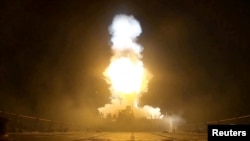
WASHINGTON -- The United States struck targets around southern Iran in response to Tehran's attacks on shipping in the Strait of Hormuz, prompting Iranian attacks on its Gulf neighbors, sparking claims from Bahrain that civilians were targeted.
Explosions were reported throughout the morning on July 13 in several parts of Iran, including just before midday in the port city of Bandar Abbas and the island of Qeshm in the strait, a key waterway for energy transport.
The US Central Command (CENTCOM) said in a statement that its forces had launched "more strikes against Iran to continue degrading their ability to attack civilian mariners and commercial ships freely transiting the Strait of Hormuz."
A second statement issued late in the morning on July 13 added that the wave of strikes had been completed.
"CENTCOM forces struck Iranian military air-defense systems, coastal radar sites, missile and drone capabilities, and small boats using U.S. fighter aircraft, naval vessels, one-way attack aerial drones, and one-way attack sea drones for the first time," CENTCOM said.
"The Strait of Hormuz is a vital maritime corridor for global trade. Iran does not control it."

US Gulf Arab allies also reported incoming Iranian projectiles, launched in retaliation for US actions.
Iran's Islamic Revolutionary Guards Corps (IRGC) said it had targeted US military facilities in Bahrain and Kuwait, destroyed radar systems in Oman, and hit fuel tanks and ammunition depots at Prince Hassan Air Base in Jordan. The claims could not be immediately verified.
Bahrain said it "successfully intercepted and destroyed several treacherous Iranian aerial attacks," accusing Tehran of launching "unlawful missile and drone attacks targeting civilians."
"It [Bahrain's General Command] stressed that the deliberate use of missiles and drones to target civilians and private property constitutes a flagrant violation of international humanitarian law," the statement added.
The exchanges of attacks by both sides over the weekend mark a sharp escalation in the conflict, casting further doubt on an interim agreement signed last month to reopen the strait and halt hostilities while the sides pursued a further 60 days of peace negotiations.
US President Donald Trump said last week the Memorandum of Understanding was void in his mind, though he added that negotiators could continue to hold talks if they felt progress could be made on a peace accord.
But a weekend of attacks has dimmed those prospects even further.
Trump told CNN on July 12 that "We hit them very hard last night" and claimed that Washington and Tehran were close to a deal before the latest exchange of fire.
"They were giving up everything, and then all of a sudden two hours after that, they hit a ship with a drone. These people, there is something wrong with them," he said.
“They’re very, very evil and sick people,” he said in a separate interview with NBC. “We had meetings with them. They agreed to a deal yesterday, a perfect deal for us. No nuclear, no this, no that, no nothing. They gave up everything."
"And then after that, they left the room. And then within an hour, they launched a drone at a ship. I said, '“You people are sick. You’re sick people.'”
Trump also claimed that, despite Iranian comments to the contrary, traffic was moving through the strategically important strait. "It's open," Trump told NBC.
CENTCOM also claimed the waterway -- through which 20 percent of the world's crude oil and gas supplies transited prewar -- was still open for shipping.

Iranian Foreign Minister Abbas Araqchi met Omani Foreign Minister Sayyid Badr Albusaidi over the weekend to discuss mechanisms for ensuring safe navigation through the Strait of Hormuz, according to Tehran.
Earlier, Oman said discussions with Iran would continue at both the technical and political levels in an effort to reach agreements consistent with international law regarding navigation through the waterway.
There were no US officials participating in those discussions.
RFE/RL has learned from diplomatic sources that Omani mediators handed proposals to the Iranian delegation aimed at resolving disputes over maritime navigation. Senior officials declined to comment on the substance of the proposals.
According to diplomatic sources familiar with the discussions, Iran left the negotiations saying it would return after reaching a unified internal position on proposals that would have allowed freedom of navigation through Omani waters in the southern part of the strait without tolls.

Shortly afterward, Iran's national security apparatus responded by firing on a commercial vessel and announcing the closure of the waterway.
In recent months, Trump has promoted what he has called the "Southern Highway" -- a shipping route that keeps vessels closer to Oman's coastline and farther from Iranian territorial waters.
Tehran has repeatedly insisted that only its preferred route, running closer to the Iranian coast, is considered safe and has previously been accused of targeting vessels using the Omani route.
War Of Words Raises Risks
The latest confrontation unfolded against an increasingly volatile political backdrop. Iran's new Supreme Leader Mojtaba Khamenei vowed revenge for the killing of his father and predecessor, Ali Khamenei, saying retaliation "must inevitably be carried out."
Ali Khameni, who was killed in US and Israel air strikes on February 28 as the war broke out, was buried on July 9 at the Imam Reza shrine in Mashhad.
"This matter depends neither on my personal existence nor on that of other officials. Whether we are present or not, it will come to pass," he said, adding that Iran had compiled a list of individuals to be targeted.
Hours earlier, Trump warned that any assassination attempt against him would trigger overwhelming US military retaliation.

"1000 missiles are locked and loaded and aimed at the Islamic Republic of Iran, with thousands more to immediately follow," Trump wrote on Truth Social, saying the United States would "completely decimate" Iran if such a threat materialized.
The exchanges come after an interim cease-fire that had briefly paused fighting following the war that erupted in late February with large-scale US-Israeli strikes on Iran. Trump has since declared the cease-fire effectively over while saying he remains open to renewed negotiations.
Diplomatic Window Narrowing
Analysts said Iran's decision to close the Strait of Hormuz and attack commercial shipping marked another setback for diplomatic efforts.
"The Iranian regime is proving once again that when the US outstretches a hand in the spirit of diplomacy it is met with a clenched fist from Tehran," Jason Brodsky, policy director at United Against Nuclear Iran, told RFE/RL.
“The US will need to escalate to send a message to the Islamic republic.”