


Accessibility links

Breaking News

Facing Mass Protests Calling For Him To Resign, Armenia's Prime Minister Is Running Out Of Options

Armenia's embattled prime minister, Nikol Pashinian (file photo)

YEREVAN -- The Armenian capital has witnessed weeks of demonstrations with protesters' calls now growing louder for Prime Minister Nikol Pashinian to step down.

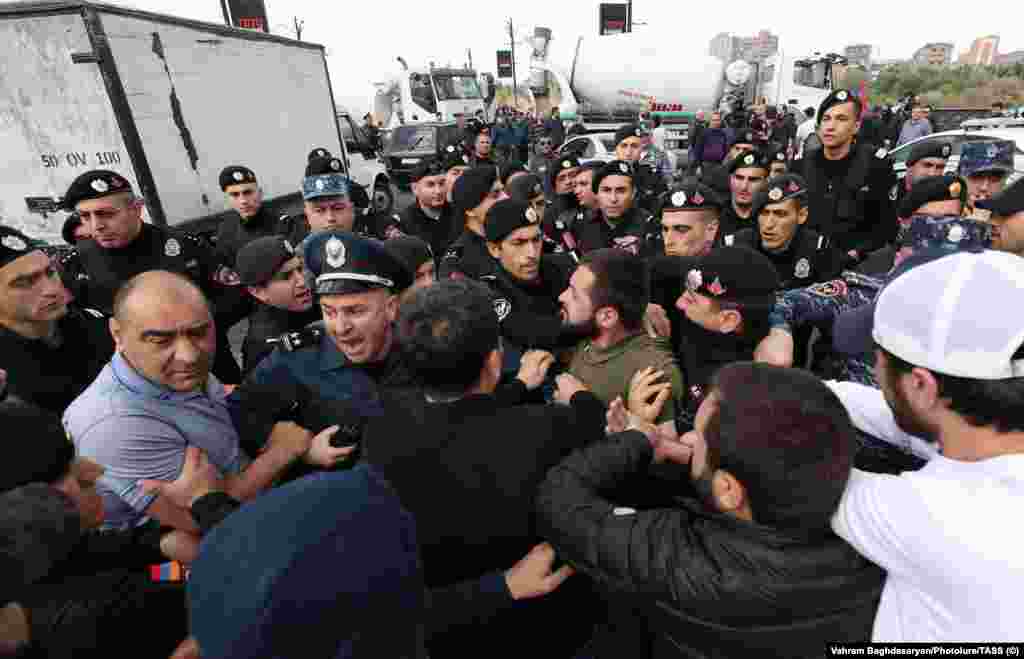
The demonstrations in Yerevan have intensified in recent days with dozens having been arrested amid clashes with police outside the parliament in what has been described as some of the worst unrest since snap elections in September 2021.

Demonstrators Clash With Police As Anti-Government Protests Continue In Armenia
please wait

No media source currently available

0:00 0:01:12 0:00

Opponents accuse Pashinian not only of bungling the 2020 war with Azerbaijan over the disputed territory of Nagorno-Karabakh, but claim his recent statements on the mainly ethnic-Armenian region indicate that his government is ready to make concessions to reach a formal peace deal with Azerbaijan.

Baku wants the peace deal to be based on five elements, including a mutual recognition of each other's territorial integrity -- and Pashinian has publicly stated that the elements are acceptable to Yerevan in principle.

That has angered many Armenians, many of whom have long called for the status of Nagorno-Karabakh to be resolved. Under Baku's five-point plan, there would be nothing to solve, since both sides would have given up any territorial claims on the other.

Protests Continue In Armenia Over Nagorno-Karabakh 'Concession' Fears
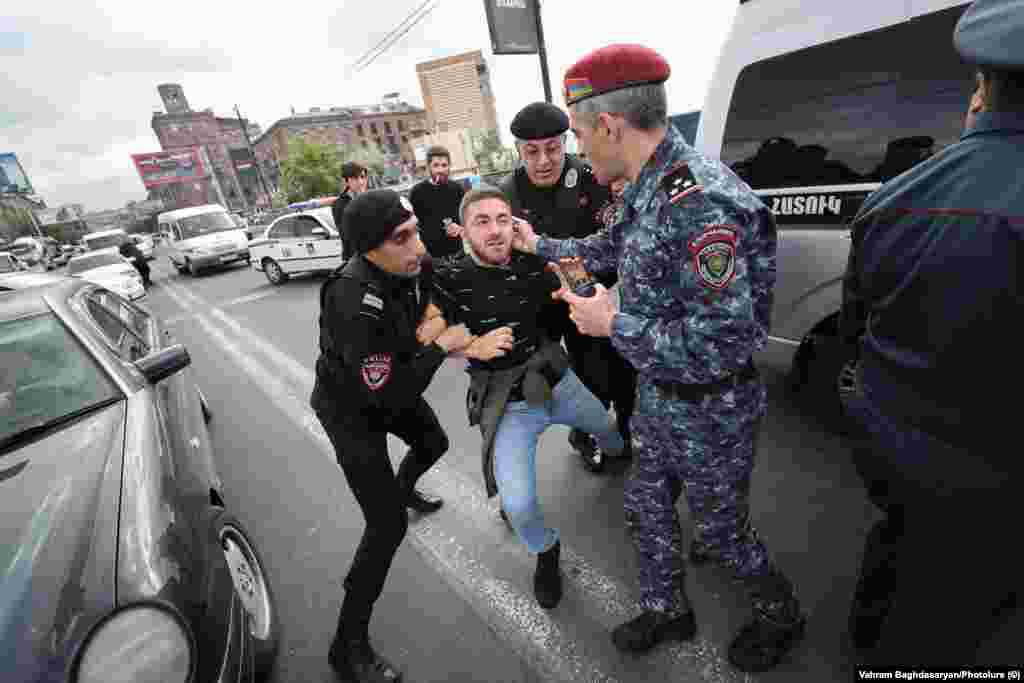
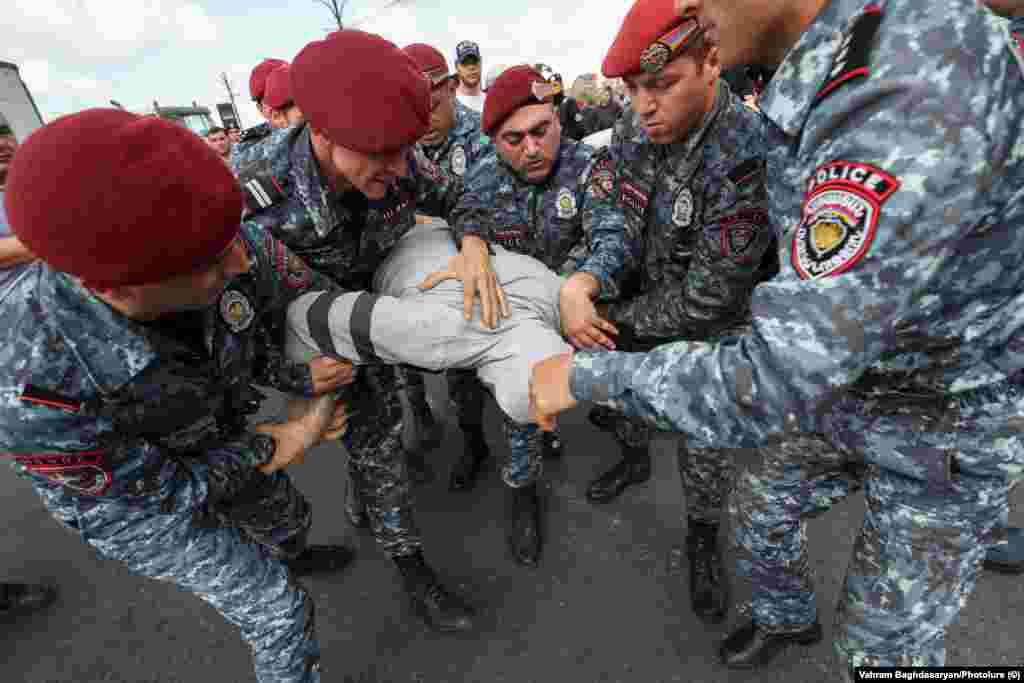
Armenian police forcibly detain a protester in Yerevan on May 4.<br />
<br />
Ongoing anti-government protests began on May 1 in the Armenian capital over fears that Prime Minister Nikol Pashinian is poised to make major concessions to Azerbaijan over the disputed Nagorno-Karabakh region.&nbsp;
1/12 Armenian police forcibly detain a protester in Yerevan on May 4.

Ongoing anti-government protests began on May 1 in the Armenian capital over fears that Prime Minister Nikol Pashinian is poised to make major concessions to Azerbaijan over the disputed Nagorno-Karabakh region. 
Thousands take to the streets of Yerevan and hundreds are arrested after Armenia's prime minister appears to hint at a handover of long-disputed land to Azerbaijan. Armenia and Azerbaijan have long been at odds over the Nagorno-Karabakh region. In 2020, Azerbaijan's military recaptured several regions that had been under control of ethnic Armenian forces since the 1990s.
Police surround protesters in Yerevan on May 3.<br />
<br />
On April 13, Pashinian told parliament: &quot;I am guilty that in 2018-19 I did not stand before our society and relay that all of our -- I repeat, all of our -- friends near and far expect us to hand over seven famous [disputed regions in and around Nagorno-Karabakh] to Azerbaijan in one way or another...&quot;
2/12 Police surround protesters in Yerevan on May 3.

On April 13, Pashinian told parliament: "I am guilty that in 2018-19 I did not stand before our society and relay that all of our -- I repeat, all of our -- friends near and far expect us to hand over seven famous [disputed regions in and around Nagorno-Karabakh] to Azerbaijan in one way or another..."
Thousands take to the streets of Yerevan and hundreds are arrested after Armenia's prime minister appears to hint at a handover of long-disputed land to Azerbaijan. Armenia and Azerbaijan have long been at odds over the Nagorno-Karabakh region. In 2020, Azerbaijan's military recaptured several regions that had been under control of ethnic Armenian forces since the 1990s.
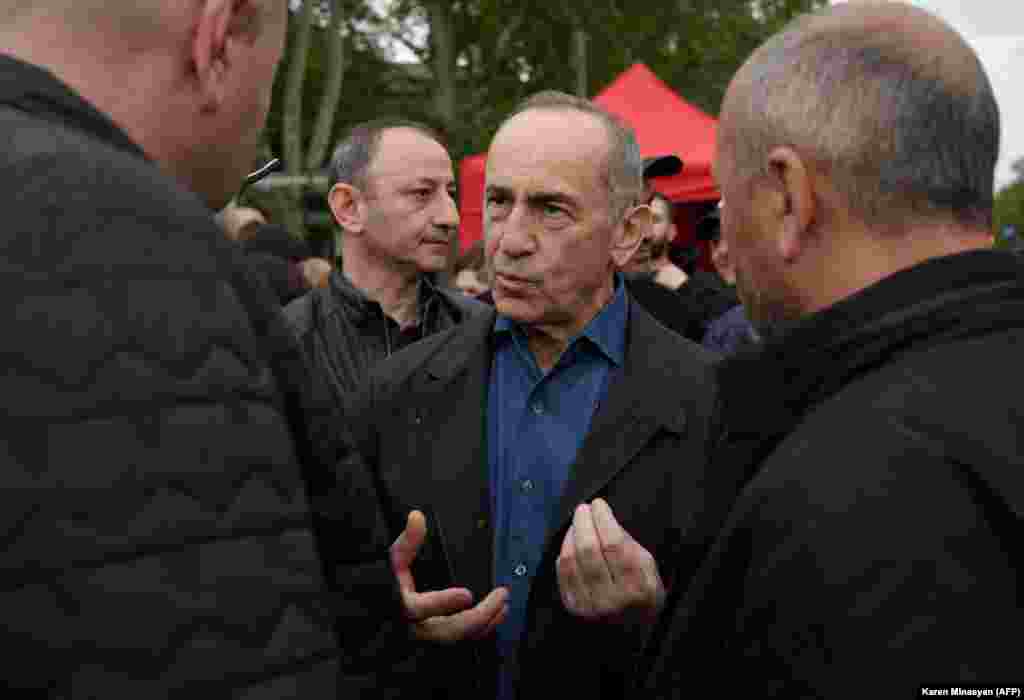
Former Armenian President Robert Kocharian speaks with protesters in Yerevan on May 3.&nbsp;<br />
<br />
Opposition figures that organized the protests accuse Pashinian of planning to let Azerbaijan take full control over Nagorno-Karabakh and demand the prime minister&#39;s resignation.
3/12 Former Armenian President Robert Kocharian speaks with protesters in Yerevan on May 3. 

Opposition figures that organized the protests accuse Pashinian of planning to let Azerbaijan take full control over Nagorno-Karabakh and demand the prime minister's resignation.
Thousands take to the streets of Yerevan and hundreds are arrested after Armenia's prime minister appears to hint at a handover of long-disputed land to Azerbaijan. Armenia and Azerbaijan have long been at odds over the Nagorno-Karabakh region. In 2020, Azerbaijan's military recaptured several regions that had been under control of ethnic Armenian forces since the 1990s.
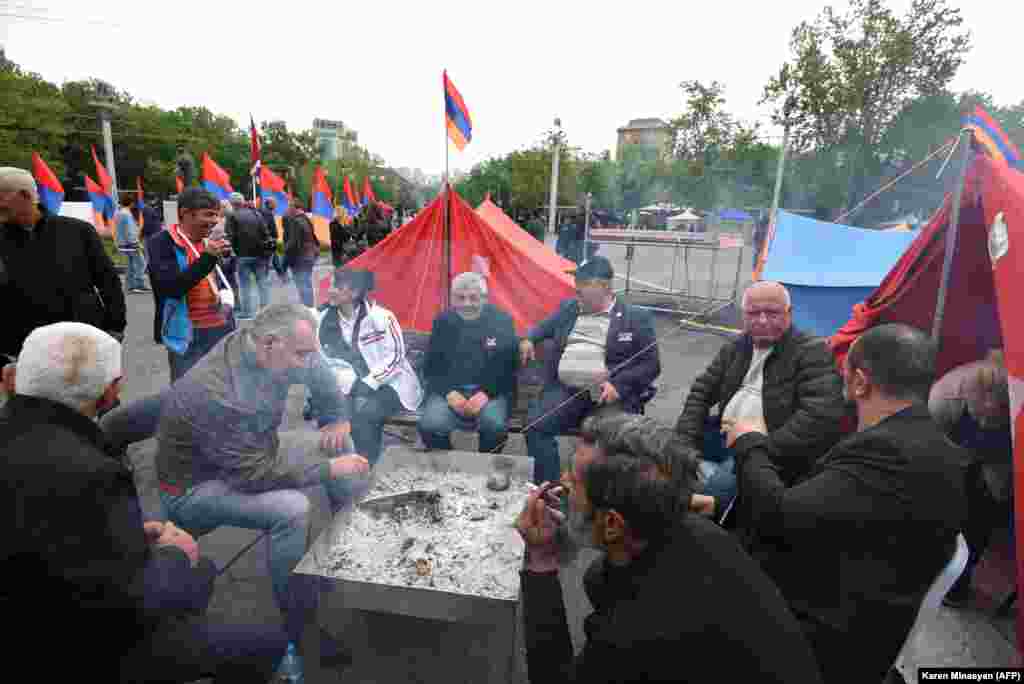
Demonstrators encamped in central Yerevan on May 3.<br />
<br />
Pashinian has also come under fire recently for the death of a pregnant woman who was killed <a href="https://www.azatutyun.am/a/31823882.html" target="_self">after being struck by a car in his motorcade</a> in April.&nbsp;
4/12 Demonstrators encamped in central Yerevan on May 3.

Pashinian has also come under fire recently for the death of a pregnant woman who was killed after being struck by a car in his motorcade in April. 
Thousands take to the streets of Yerevan and hundreds are arrested after Armenia's prime minister appears to hint at a handover of long-disputed land to Azerbaijan. Armenia and Azerbaijan have long been at odds over the Nagorno-Karabakh region. In 2020, Azerbaijan's military recaptured several regions that had been under control of ethnic Armenian forces since the 1990s.
Armenian singer Sirusho performs during a demonstration in Yerevan calling for the resignation of Pashinian.&nbsp;<br />
<br />
More than 200 people were detained by police on May 3, the day this photo was taken.&nbsp;&nbsp;
5/12 Armenian singer Sirusho performs during a demonstration in Yerevan calling for the resignation of Pashinian. 

More than 200 people were detained by police on May 3, the day this photo was taken.  
Thousands take to the streets of Yerevan and hundreds are arrested after Armenia's prime minister appears to hint at a handover of long-disputed land to Azerbaijan. Armenia and Azerbaijan have long been at odds over the Nagorno-Karabakh region. In 2020, Azerbaijan's military recaptured several regions that had been under control of ethnic Armenian forces since the 1990s.
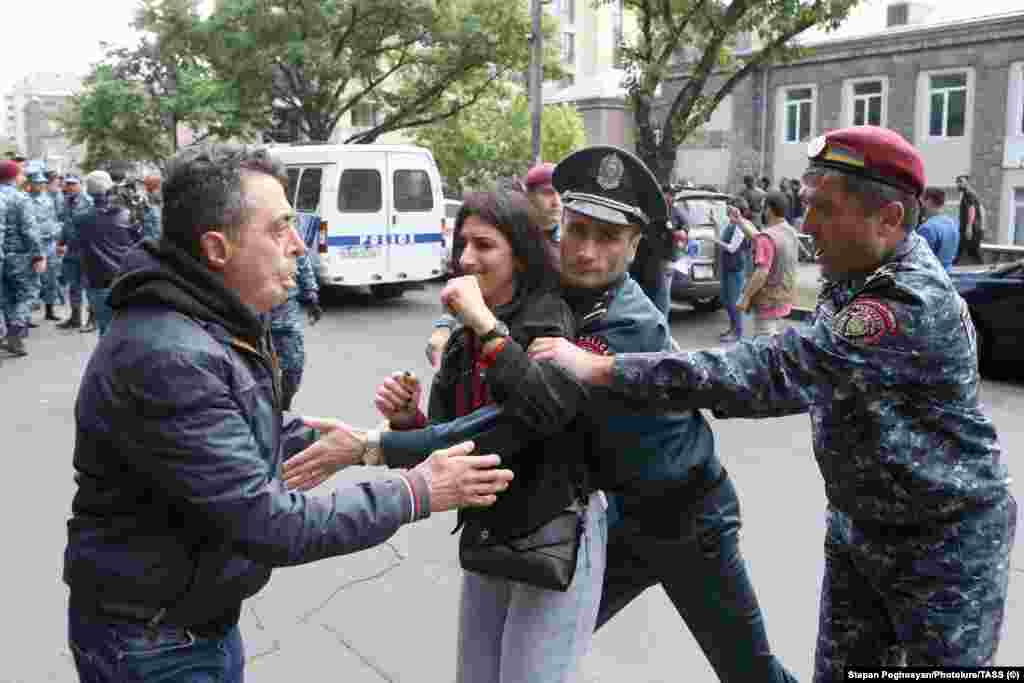
A woman is detained by police in Yerevan on May 3.&nbsp;<br />
<br />
The prime minister&#39;s political allies accuse the opposition of exploiting the Karabakh issue in a bid to seize power. They point to recent elections that reinstated the ruling party after the large-scale conflict with Azerbaijan in 2020.&nbsp;
6/12 A woman is detained by police in Yerevan on May 3. 

The prime minister's political allies accuse the opposition of exploiting the Karabakh issue in a bid to seize power. They point to recent elections that reinstated the ruling party after the large-scale conflict with Azerbaijan in 2020. 
Thousands take to the streets of Yerevan and hundreds are arrested after Armenia's prime minister appears to hint at a handover of long-disputed land to Azerbaijan. Armenia and Azerbaijan have long been at odds over the Nagorno-Karabakh region. In 2020, Azerbaijan's military recaptured several regions that had been under control of ethnic Armenian forces since the 1990s.
A protester is detained in Yerevan on May 4.<br />
<br />
Pashinian&#39;s Civil Contract party holds 71 of the legislature&#39;s 101 seats since snap elections were called in June 2021.&nbsp;
7/12 A protester is detained in Yerevan on May 4.

Pashinian's Civil Contract party holds 71 of the legislature's 101 seats since snap elections were called in June 2021. 
Thousands take to the streets of Yerevan and hundreds are arrested after Armenia's prime minister appears to hint at a handover of long-disputed land to Azerbaijan. Armenia and Azerbaijan have long been at odds over the Nagorno-Karabakh region. In 2020, Azerbaijan's military recaptured several regions that had been under control of ethnic Armenian forces since the 1990s.
Trucks block a bridge in central Yerevan on the morning of May 4. The truckers claimed to police that their vehicles had broken down.&nbsp;
8/12 Trucks block a bridge in central Yerevan on the morning of May 4. The truckers claimed to police that their vehicles had broken down. 
Thousands take to the streets of Yerevan and hundreds are arrested after Armenia's prime minister appears to hint at a handover of long-disputed land to Azerbaijan. Armenia and Azerbaijan have long been at odds over the Nagorno-Karabakh region. In 2020, Azerbaijan's military recaptured several regions that had been under control of ethnic Armenian forces since the 1990s.
A scuffle breaks out near the trucks on Yerevan&#39;s Kievyan Bridge on May 4.<br />
<br />
Roadblocks were a key part of the protests that brought Prime Minister Nikol Pashinian to power in the spring of 2018.&nbsp;
9/12 A scuffle breaks out near the trucks on Yerevan's Kievyan Bridge on May 4.

Roadblocks were a key part of the protests that brought Prime Minister Nikol Pashinian to power in the spring of 2018. 
Thousands take to the streets of Yerevan and hundreds are arrested after Armenia's prime minister appears to hint at a handover of long-disputed land to Azerbaijan. Armenia and Azerbaijan have long been at odds over the Nagorno-Karabakh region. In 2020, Azerbaijan's military recaptured several regions that had been under control of ethnic Armenian forces since the 1990s.
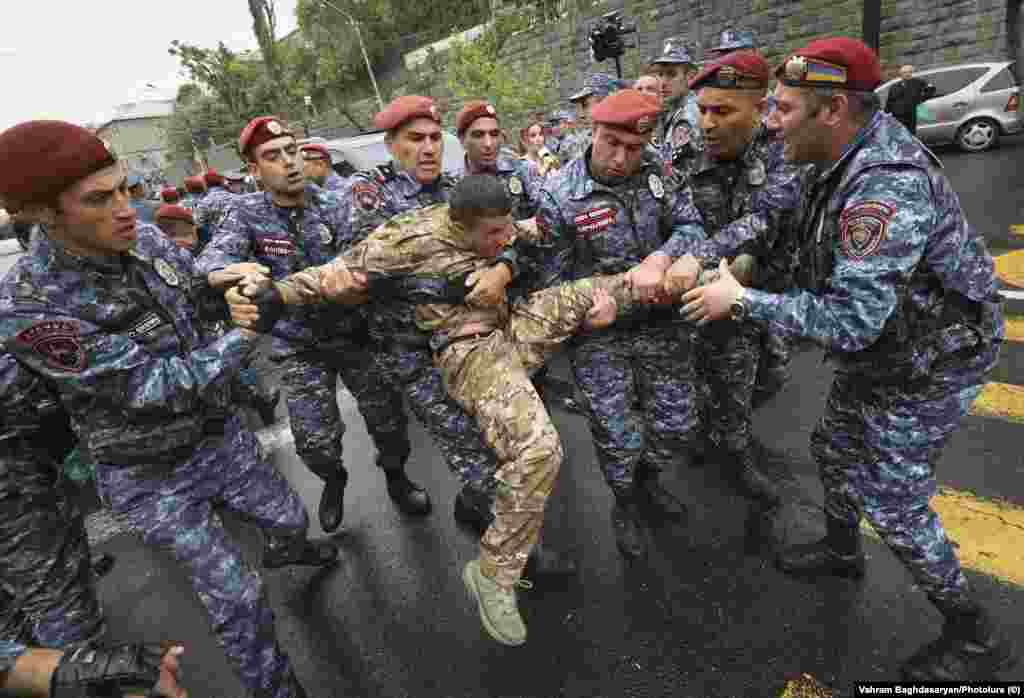
A man in military clothing grapples with police in Yerevan on May 2.<br />
<br />
Yerevan residents that RFE/RL&#39;s Armenian Service spoke to on May 3 expressed mixed feelings about the unrest, with one saying, &quot;In democratic countries, governments are formed through elections.&nbsp;Period.&quot;
10/12 A man in military clothing grapples with police in Yerevan on May 2.

Yerevan residents that RFE/RL's Armenian Service spoke to on May 3 expressed mixed feelings about the unrest, with one saying, "In democratic countries, governments are formed through elections. Period."
Thousands take to the streets of Yerevan and hundreds are arrested after Armenia's prime minister appears to hint at a handover of long-disputed land to Azerbaijan. Armenia and Azerbaijan have long been at odds over the Nagorno-Karabakh region. In 2020, Azerbaijan's military recaptured several regions that had been under control of ethnic Armenian forces since the 1990s.
A dog is seen during the arrest of a protester on May 4.<br />
<br />
Another Yerevan resident said, &ldquo;I&#39;m not a big fan of Mr.&nbsp;Pashinian, but these [protesters] need to specify their first, second, and third steps [after toppling the government].&quot;&nbsp;
11/12 A dog is seen during the arrest of a protester on May 4.

Another Yerevan resident said, “I'm not a big fan of Mr. Pashinian, but these [protesters] need to specify their first, second, and third steps [after toppling the government]." 
Thousands take to the streets of Yerevan and hundreds are arrested after Armenia's prime minister appears to hint at a handover of long-disputed land to Azerbaijan. Armenia and Azerbaijan have long been at odds over the Nagorno-Karabakh region. In 2020, Azerbaijan's military recaptured several regions that had been under control of ethnic Armenian forces since the 1990s.
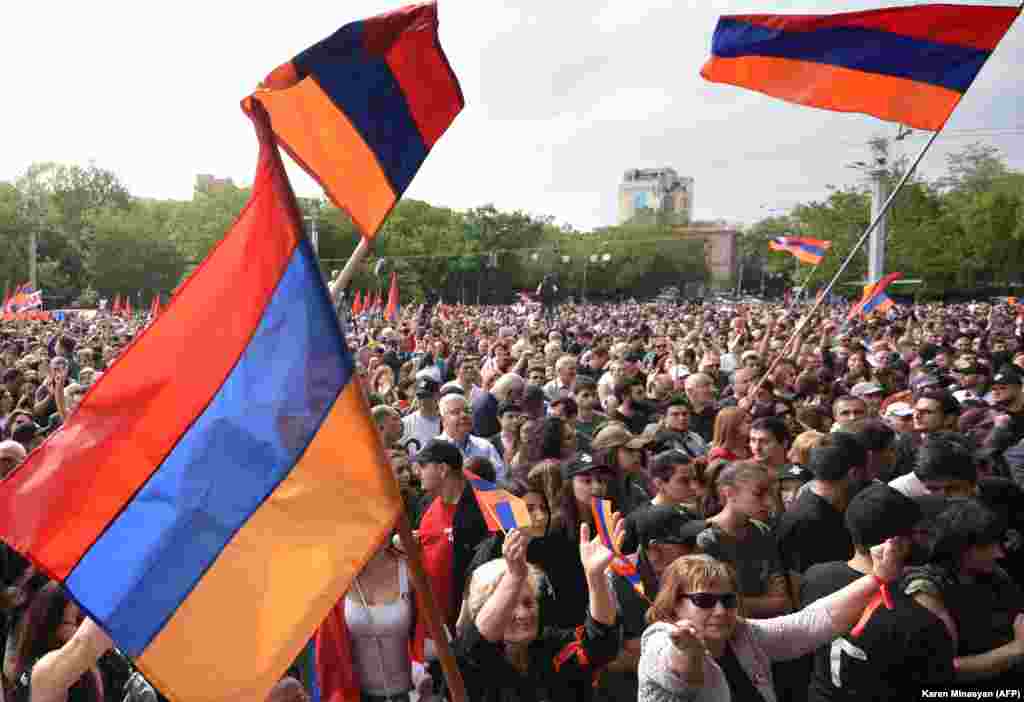
Thousands of protesters gather in central Yerevan on May 1, when a massive demonstration warned the government not to concede further territory to Baku.&nbsp;
12/12 Thousands of protesters gather in central Yerevan on May 1, when a massive demonstration warned the government not to concede further territory to Baku. 
Thousands take to the streets of Yerevan and hundreds are arrested after Armenia's prime minister appears to hint at a handover of long-disputed land to Azerbaijan. Armenia and Azerbaijan have long been at odds over the Nagorno-Karabakh region. In 2020, Azerbaijan's military recaptured several regions that had been under control of ethnic Armenian forces since the 1990s.
Previous slide
Next slide

Besides a tougher diplomatic line, Baku has taken other bolder action in recent months, including military buildups along the border of the two countries and some military maneuvering to push deeper into Armenian-held territory.

After the breakup of the Soviet Union, Azerbaijan and Karabakh Armenians -- backed by Yerevan -- went to war, leading to mass displacement and ethnic cleansing. In 1994, the two sides signed a cease-fire agreement, leaving the Armenian side with de facto control of the Nagorno-Karabakh region and surrounding territories that belonged to Azerbaijan.

Attempts to negotiate a durable peace agreement by the United States, Russia, and France under the auspices of the Minsk Group of the Organization for Security and Cooperation in Europe (OSCE) have proved unsuccessful. Major fighting broke out in 2016 and 2020.

The 45-day conflict in 2020 claimed more than 6,500 lives. It ended with a Russian-brokered cease-fire after Azerbaijani forces had taken back most of the territories it had lost two decades earlier, leaving Armenians in possession of much less territory.
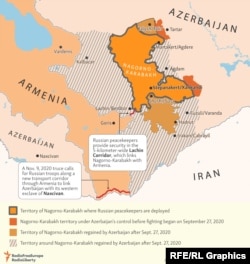
With Russia -- which has had a military force deployed in areas controlled by Armenia since the end of the 2020 Nagorno-Karabakh war -- bogged down in Ukraine, analysts say Baku is now emboldened.

"I do think the 'five-point proposal' was certainly facilitated by the Ukraine war with Baku taking advantage of Russian and Western distraction, along with Armenia recognizing that they cannot depend on Russia any more after 2020. Mainly Russian difficulties in peacekeeping and the unpredictable nature of the country," explained Paul Stronski, a senior fellow at the Carnegie Foundation's Russia and Eurasia Program, in e-mailed remarks to RFE/RL.

"Negotiations are indeed proceeding at a time of deep uncertainty in the region due to the Ukraine war," added Stronski, a former White House and State Department official.

Baku Takes Territory, Cuts Energy

Weeks after Russia launched its assault on Ukraine, Baku took aggressive steps in Nagorno-Karabakh. On March 8, a key pipeline supplying gas to the Karabakh Armenian population was cut off on Azerbajani-held territory, leaving those living there without heat for two weeks.

Azerbaijani forces then advanced into areas ostensibly under Russian peacekeeper control, forcing the evacuation of one Armenian village and taking control of strategic mountains inside Armenian-populated areas. Three local Armenian fighters were killed and 15 wounded on March 25 after Azerbaijan reportedly launched drone strikes.
To justify its actions, Baku pointed to the 2020 cease-fire agreement which stipulates the withdrawal of Armenian troops, although the status of local Karabakh Armenian forces -- the self-styled Nagorno-Karabakh Defense Army -- is left ambiguous under terms of the truce.

"Azerbaijan has been testing the will and capacity of the Russian peacekeepers in Nagorno-Karabakh, as their presence is the one major drawback from Azerbaijan's perspective in the cease-fire terms agreed in November 2020. Baku has insisted all along that they are temporary, as it wants to avoid their becoming a central component of some new 'frozen' situation," explained Laurence Broers, an associate fellow of the Russia and Eurasia Program at Chatham House, in e-mailed comments to RFE/RL.

EU To The Rescue?

Amid rising regional tensions, the European Union facilitated a third meeting -- hosted by European Council President Charles Michel -- between Pashinian and Azerbaijani President Ilham Aliyev on April 6. The two agreed to instruct their respective foreign ministers to work on a peace treaty and convene a joint border commission by late April.

On April 12, Aliyev said that, during the April 6 meeting, Armenia had agreed to the five points spelled out by Baku, including, crucially, no territorial claims.

Addressing parliament a day later on April 13, Pashinian said Yerevan was facing international pressure to scale down its demands on the status of Nagorno-Karabakh, and that there was no alternative to peace with Azerbaijan. Pashinian also stressed that the Karabakh issue was about rights, not territories, and peace negotiations should ensure security guarantees, rights, and freedoms for Karabakh Armenians, as well as clarify the territory's final status.

European Council President Charles Michel (center), Armenian Prime Minister Nikol Pashinian (left), and Azerbaijani President Ilham Aliyev attend a trilateral meeting in Brussels last month.

On April 13, de facto Nagorno-Karabakh leader Arayik Harutyunian rejected as "impossible" Azerbaijani rule over the region, while the de facto Nagorno-Karabakh parliament on April 14 demanded an end to the "disastrous" Armenian position.

Back in Yerevan, on April 22, opposition parliamentarian and Deputy Parliament Speaker Ishkhan Saghatelian announced the start of a "nonstop street struggle" to oust Pashinian. The Armenian prime minister came to power in 2018 with massive street protests.

The current wave of demonstrations is spearheaded by Armenia's two opposition parliamentary factions -- Hayastan and Pativ Unem Alliances -- led by former presidents, Robert Kocharian and Serzh Sarkisian, respectively.

Pashinian should be able to weather the latest wave of protests, argued Stronski, who worked on Russia and Central Asian policy at the White House National Security Council from 2012 to 2014.

"The opposition repeatedly tried to tarnish [Pashinian's] image, claiming he is the most pro-Russian leader in the country's history, that he abused his power, led a disastrous war. So far, none of this has stuck because the opposition controlled by the former regime, former presidents -- all of whom have been in the public eye for far too long, offer no new ideas, and are deeply disliked by many Armenians," Stronski said.

In the West, however, Pashinian has been praised for being willing to make compromises.

Echoing the EU reaction, U.S. Secretary of State Antony Blinken praised Pashinian's conciliatory position on the Nagorno-Karabakh conflict after talks with Armenian Foreign Minister Ararat Mirzoyan in Washington on May 2.

He also said that the United States and Armenia are now working to "strengthen and deepen" their relations through a "strategic dialogue" that was launched in 2019 but subsequently suspended due to the COVID-19 pandemic.

"There is a lot of international momentum for a deal," said Stronski. "So, we'll see what happens."

Pashinian Pushed To The Corner?

Moscow, however, is suspicious that Brussels and Washington are trying to elbow it out.

Russian Foreign Minister Sergei Lavrov accused the United States and France on April 8 of refusing to work with Russia within the OSCE format following Moscow’s invasion of Ukraine.

On April 21, Russian Foreign Ministry Spokeswoman Maria Zakharova accused the West of "paralyzing" the Minsk Group and condemned the EU for "appropriating" the peace process.

Given Russia's role in the region, both Azerbaijan and Armenia have tried to remain neutral, not voting in favor, for example, of UN General Assembly resolutions condemning Russia's invasion of Ukraine or a vote to kick Russia off the UN Human Rights Council.

Pashinian and Putin reaffirmed Russia's key role in the peace process in a joint declaration issued after their face-to-face talks held on April 19.

Despites the protests on the streets at home, Pashinian's options are limited, argued Broers.

"I don't think this is just or even mainly about Western pressure, but more about a lack of any options after a devastating military defeat in 2020," he said. "Add to this additional pressures coming from Azerbaijan and also from Turkey, which appears to be biding its time on normalization with Armenia until Yerevan agrees to Baku's terms on Karabakh, and those coming from the much shakier long-term horizon for the Armenia-Russia security alliance after the war in Ukraine, you can see that Pashinian's scope for maneuver is limited."

  • 16x9 Image

    RFE/RL's Armenian Service

    RFE/RL’s Armenian Service, operating out of a bureau in Yerevan, is a leading source of trusted reporting and technical innovation, reaching outsized audiences when developments demand authoritative, up-to-the-minute news most.

  • 16x9 Image

    Tony Wesolowsky

    Tony Wesolowsky is a senior correspondent for RFE/RL in Prague, covering Belarus, Ukraine, Russia, and Central Europe, as well as energy issues. His work has also appeared in The Philadelphia Inquirer, the Christian Science Monitor, and the Bulletin Of The Atomic Scientists.

This item is part of
XS
SM
MD
LG